
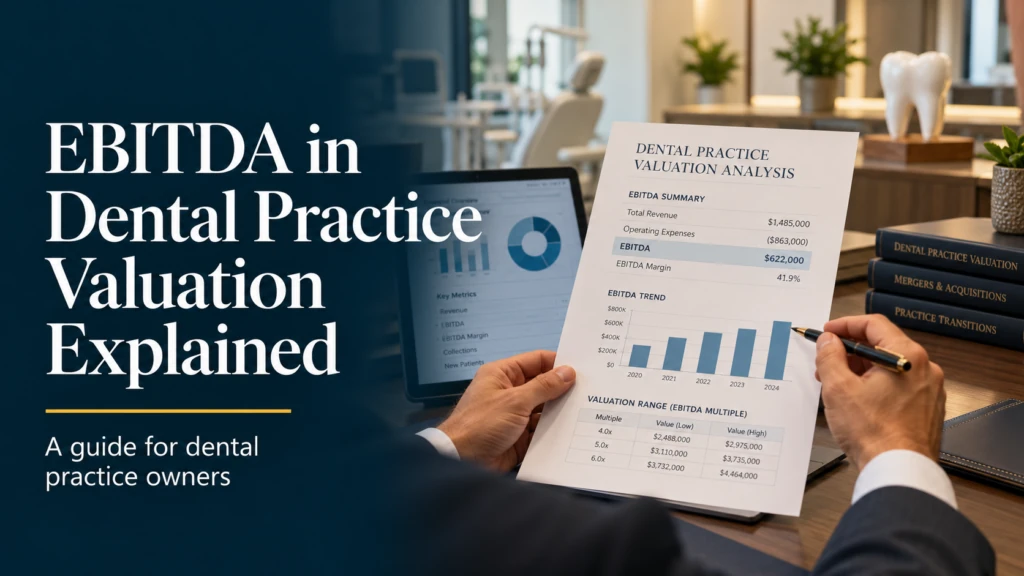
EBITDA helps dental practice owners understand their practice’s profitability and estimate its potential market value. Buyers use this financial measure to compare practices, while sellers use it to evaluate earnings before negotiating a sale.
However, adjusted EBITDA is often more useful for valuation because it accounts for owner compensation and certain expenses that may not continue after a sale.
This guide explains how to calculate dental practice EBITDA, understand valuation multiples, and avoid common financial mistakes.
What Is EBITDA in a Dental Practice?
EBITDA stands for Earnings Before Interest, Taxes, Depreciation, and Amortization. It measures a dental practice’s profitability before these financing, tax, and accounting expenses.
EBITDA helps buyers compare practices with different debt levels, tax arrangements, and equipment depreciation. It also shows how operating costs affect earnings.
Three financial terms are important:
- Revenue: Income generated from dental services.
- Net income: Profit remaining after recorded expenses.
- EBITDA: Earnings before interest, income taxes, depreciation, and amortization.
A practice with high annual collections does not always have strong EBITDA. Staff salaries, dental supplies, laboratory fees, rent, and other operating expenses affect profitability. The Corporate Finance Institute’s explanation of EBITDA shows how the metric helps compare operating profitability by excluding financing costs and certain accounting expenses.
How to Calculate EBITDA for a Dental Practice
To calculate EBITDA for a dental practice, start with net income and add back interest, income taxes, depreciation, and amortization already deducted from earnings.
EBITDA Formula:
EBITDA = Net Income + Interest + Income Taxes + Depreciation + Amortization
Consider a dental practice with these annual financial figures:
| Financial Item | Amount |
|---|---|
| Net income | $180,000 |
| Interest expense | $15,000 |
| Income tax expense | $0 |
| Depreciation and amortization | $25,000 |
| Total EBITDA | $220,000 |
The practice generates $220,000 in standard annual EBITDA before additional adjustments.
These figures generally come from profit-and-loss statements, tax records, and depreciation schedules.
Only add back expenses already deducted from net income. Income taxes do not include payroll taxes, and equipment loan principal payments are not EBITDA add-backs.
What Is Adjusted EBITDA in Dental Practice Valuation?
Adjusted EBITDA measures a practice’s ongoing earnings after accounting for reasonable owner-related and nonrecurring expense adjustments. Buyers use it to estimate profitability under new ownership.
Owner-Dentist Compensation Adjustments
An owner-dentist earns income from providing dental care and owning the business. Buyers must account for the cost of replacing the owner’s clinical work.
For example, suppose the practice reports:
- Owner’s recorded salary: $240,000
- Replacement dentist compensation: $210,000
- Net compensation adjustment: +$30,000
The adjustment reflects the difference between recorded salary and replacement costs.
Owner distributions that were never recorded as business expenses cannot be added back to EBITDA.
Common EBITDA Add-Backs
Four common adjustments include:
- Personal expenses: Non-business vehicle or travel costs paid by the practice.
- One-time expenses: Documented legal or consulting fees that will not recur.
- Family payroll: Compensation exceeding the fair value of work performed.
- Related-party rent: Adjustments needed to reflect market-rate rental costs.
Every adjustment must be supported by financial records.
Using our previous example:
| Calculation | Amount |
|---|---|
| Standard EBITDA | $220,000 |
| Owner compensation adjustment | +$30,000 |
| Documented one-time legal expense | +$10,000 |
| Adjusted EBITDA | $260,000 |
The practice’s adjusted EBITDA is $260,000, assuming both adjustments are justified.
What Is a Good EBITDA Margin for a Dental Practice?
EBITDA margin measures earnings as a percentage of practice revenue.
EBITDA Margin = (EBITDA ÷ Net Revenue) × 100
For a practice collecting $1.2 million annually with $260,000 in adjusted EBITDA, the adjusted EBITDA margin is 21.7%.
Dental practice margins differ based on specialty, staffing, laboratory costs, overhead, and owner compensation.
A higher margin generally indicates stronger operating profitability, but no single percentage guarantees a higher valuation. Compare practices using consistent revenue figures and compensation adjustments.
How Does EBITDA Affect Dental Practice Value?
Buyers can estimate dental practice value by multiplying adjusted EBITDA by an appropriate valuation multiple.
Estimated Enterprise Value = Adjusted EBITDA × Valuation Multiple
For example:
$260,000 × 5 = $1,300,000
At a hypothetical 5× multiple, the practice has an estimated enterprise value of $1.3 million.
The multiple depends on five important factors:
- Practice size and earnings consistency.
- Patient retention and hygiene revenue.
- Growth potential and location.
- Dependence on the selling dentist.
- Buyer type and market demand.
Individual dentists and Dental Service Organizations (DSOs) may use different valuation methods. DSOs commonly focus on adjusted EBITDA, while private buyers may also evaluate owner earnings and collections.
HDC helps owners assess profitability and compare potential sale options.
Enterprise value is not the seller’s final cash payment. Debt, transaction costs, earnouts, and deal structure affect proceeds. Learn more about Dental Practice Valuation Multiples.
EBITDA vs. SDE: What’s the Difference?
EBITDA measures business earnings before specified expenses, while Seller’s Discretionary Earnings (SDE) measures the financial benefit available to a working owner.
SDE typically includes the owner’s compensation and supported discretionary adjustments.
Individual dentists buying smaller practices may use SDE because they plan to provide clinical care themselves.
DSOs generally prefer adjusted EBITDA because it accounts for replacement dentist compensation.
Both methods require accurate financial records and careful expense adjustments.
Common Mistakes When Calculating Dental Practice EBITDA
Four common mistakes can produce misleading EBITDA figures:
- Confusing EBITDA with cash flow: EBITDA excludes equipment purchases, loan principal payments, and working capital needs.
- Using unsupported add-backs: Regular operating expenses cannot be removed without a valid reason.
- Ignoring owner compensation: Replacement dentist costs must reflect actual clinical responsibilities.
- Overlooking financial records: Missing expenses or inaccurate reporting can distort earnings.
Buyers examine these issues during Dental Practice Due Diligence.
How to Prepare EBITDA Before Selling Your Dental Practice
Prepare accurate financial records before requesting a dental practice valuation.
Review three years of profit-and-loss statements, tax returns, payroll records, and collection reports. Document legitimate add-backs and separate recurring expenses from one-time costs.
Houston Dental Consulting helps dentists evaluate financial performance, practice location, and buyer expectations in Houston, Texas.
A dental-focused CPA can verify accounting adjustments before the sale process.
Conclusion
EBITDA provides a starting point for understanding dental practice profitability and potential market value. Accurate calculations, reasonable adjustments, and buyer-specific valuation methods help owners make informed selling decisions. Houston Dental Consulting helps dentists review practice earnings, valuation factors, and sale options.
Contact HDC to request a confidential consultation about your dental practice’s potential value.
Frequently Asked Questions
Is EBITDA the Same as a Dentist’s Take-Home Pay?
No. EBITDA measures business earnings before certain expenses. Take-home pay depends on salary, owner distributions, taxes, and available cash.
Do All Dental Practice Buyers Use EBITDA?
No. DSOs commonly use adjusted EBITDA, while individual dentist buyers may also consider SDE, collections, and cash flow.
How Often Should Dental Practice Owners Review EBITDA?
Review EBITDA quarterly and before selling a practice. Regular reviews help identify changes in earnings, expenses, and operational profitability.
What Is a Good EBITDA Margin for a Dental Practice?
An EBITDA margin of 18%–25% is a commonly cited benchmark, but actual results vary by specialty, overhead, and owner compensation adjustments.
What EBITDA Multiple Is Used to Value a Dental Practice?
There is no fixed multiple. Valuation multiples depend on practice size, profitability, buyer type, growth potential, and dependence on the owner-dentist.