
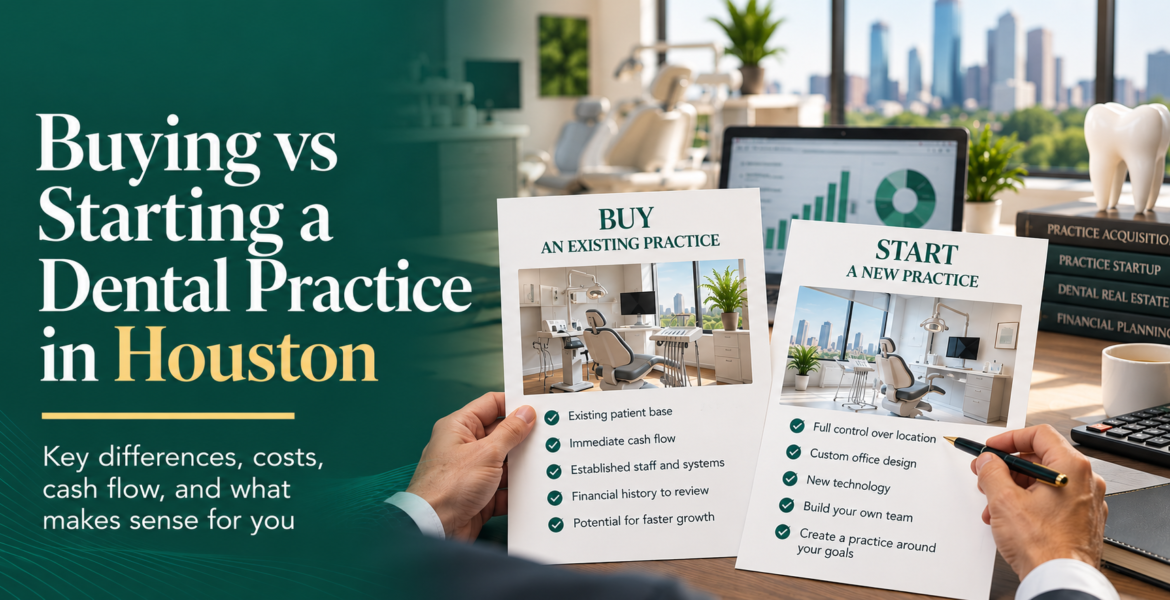
Buying an existing dental practice gives you an operating business with patients, revenue history, staff, and systems to evaluate, while starting a new practice gives you more control over the location, design, technology, and practice model. Neither option is automatically cheaper or better.
The right decision depends on total investment, expected cash flow, patient demand, clinical goals, financing, and the quality of the opportunity available.
Houston Dental Consulting helps dentists compare practice opportunities and understand the financial, operational, and transition factors involved before making an ownership decision.
Buying vs Starting a Dental Practice: Key Differences
There are 5 main differences between buying an existing dental practice and starting one: patients, revenue, staff, office setup, and ownership risk.
| Factor | Buying an Existing Practice | Starting a New Practice |
|---|---|---|
| Patients | Existing patient relationships to maintain | Patient base must be developed |
| Revenue | Historical collections can be reviewed | Revenue depends on future patient growth |
| Team | Existing staff and systems may remain | Staff must be hired and trained |
| Office | Existing layout and equipment | More control over design and technology |
| Main challenge | Managing the ownership transition | Funding the opening and early growth |
An acquisition gives a buyer more historical information to evaluate. A startup gives the owner more control, but financial projections depend heavily on how quickly patients begin scheduling and returning for treatment.
Which Option Costs More?
Compare the complete cost of each ownership path before deciding whether buying or starting is less expensive. An acquisition price and a startup construction budget do not represent the same costs.
The Full Cost of Buying a Practice
Buying an existing dental practice can involve:
- Practice purchase price
- Legal and accounting costs
- Practice valuation and due diligence
- Working capital
- Equipment replacement
- Technology upgrades
- Renovations
- Operational changes
The purchase price may include tangible assets such as equipment and furnishings and intangible value such as goodwill. Goodwill reflects factors such as patient relationships, reputation, and the established business presence.
The asking price alone does not show whether a practice is affordable. Buyers also need to understand collections, operating expenses, debt payments, equipment needs, and how much revenue is likely to continue after the seller leaves.
The Full Cost of Starting a Practice
Starting a dental practice creates a different set of expenses, including:
- Lease deposits
- Dental office build-out
- Chairs and clinical equipment
- Imaging and sterilization equipment
- Computers and practice software
- Recruitment and training
- Initial supplies
- Marketing
- Working capital
Owners should also maintain a separate personal reserve for living expenses.
A completed dental office does not automatically produce enough income to support the owner. Patients still need to discover the practice, schedule appointments, accept treatment, and return for continuing care.
How Do Cash Flow and Financing Compare?
Cash flow depends on the money remaining after operating costs and debt payments, not simply the amount collected by the practice.
A simple cash-planning calculation is:
Collections − operating expenses − loan payments − equipment reserves = cash available for owner pay and taxes
For example, a practice may collect substantial monthly revenue but still have limited cash available after payroll, rent, supplies, insurance, loan payments, and equipment expenses.
An acquisition provides financial records that lenders and buyers can review, including historical collections, expenses, tax returns, and production reports.
A startup relies more heavily on projections. The business plan must estimate patient growth, operating expenses, working capital needs, and the time required for collections to support the business.
Opening the office, generating revenue, covering expenses, and producing enough cash for owner compensation are 4 different financial milestones.
When Does Buying an Existing Dental Practice Make Sense?
Buying makes sense when the practice has verifiable financial performance, an active patient base, suitable clinical services, and a transition the buyer can realistically manage.
Dentists comparing acquisition opportunities can review current dental practices for sale based on location, practice type, budget, patient base, and ownership goals.
Review at least these 7 areas:
- Collections and profitability
- Active patient activity
- Hygiene and recall systems
- Payer mix
- Staff continuity
- Equipment condition
- Seller transition support
Clinical fit also matters. A buyer should understand which procedures produce the seller’s revenue. Historical collections may be difficult to maintain when a significant portion comes from treatments the buyer does not provide.
The payer mix should also fit the buyer’s intended business model. PPO participation, fee-for-service patients, Medicaid participation, and other payment arrangements can affect revenue and patient retention.
Buying does not remove risk. Aging equipment, weak systems, employee turnover, poor lease terms, or patient attrition can change the financial value of the opportunity.
A detailed buyer checklist helps organize the financial records, patient activity, staff details, equipment, lease terms, and transition items that should be reviewed before closing.
Dentists who need support evaluating appraisals, practice information, financing considerations, and acquisition risk can also use buyer representation during the transaction process.
When Does Starting a New Dental Practice Make Sense?
Starting a practice can make sense when available acquisitions cannot provide the location, layout, capacity, technology, or clinical model the dentist needs.
A startup gives the owner more control over:
- Office location
- Operatory layout
- Equipment
- Technology
- Staffing
- Brand
- Services
- Patient experience
That freedom comes with additional responsibility.
The owner must manage site selection, construction, equipment installation, hiring, systems, marketing, and early operating expenses while building a patient base.
One question should be answered before committing significant capital:
Where will the first patients come from, and what will make them return?
A strong startup plan should connect local patient demand with services, insurance participation, marketing, staffing, and realistic financial projections.
What Should You Check Before Choosing a Houston Location?
Evaluate the actual property and surrounding patient market before choosing a dental office location.
Important factors include:
- Local patient demographics
- Nearby dental practices
- Insurance participation
- Parking
- Visibility
- Road access
- Available operatories
- Expansion potential
- Rent and occupancy costs
Lease terms also matter. Review assignment rights, remaining lease length, renewal options, rent increases, landlord approval requirements, and planned improvements.
Property-level conditions should be evaluated as well, including previous flooding, drainage, building access, and potential interruptions during severe weather.
Do not assume that a growing neighborhood automatically creates a good startup opportunity or that an established area automatically makes an acquisition better. The individual site, patient market, and financial structure matter more than the area’s reputation alone.
Houston Dental Consulting can help buyers evaluate available dental offices alongside the practice, location, lease, and transition factors connected to the purchase.
Choose the Ownership Path That Fits Your Goals
The better ownership path is the one that supports your clinical goals, financial needs, and acceptable level of risk under realistic assumptions.
Compare a specific acquisition with a complete startup budget rather than choosing based only on purchase price, office appearance, or projected revenue.
HDC helps dentists review available practices, buyer representation needs, valuation factors, location considerations, and transition risks before moving toward ownership.
Dentists who are ready to compare a specific acquisition with their ownership goals can schedule a consultation to discuss available practices, financial considerations, and the next steps in the buying process.
Frequently Asked Questions
Q. Can I Buy an Older Dental Practice and Update It Gradually?
Yes, an older practice can be updated gradually when the existing equipment and facility remain safe and functional. Separate necessary improvements from cosmetic changes. Equipment replacement, compliance issues, and repairs may need immediate attention, while branding, décor, software, and other improvements can often be introduced over time to reduce disruption and preserve working capital.
Q. Is Buying a Fitted Dental Office the Same as Buying an Established Practice?
No. A fitted dental office provides physical infrastructure, while an established practice includes an operating business with patient activity and revenue history. A space may contain chairs, equipment, plumbing, and dental technology without having dependable collections or transferable patient relationships. Financially, such an opportunity may operate more like a startup than a traditional acquisition.
Q. Can I Work as an Associate While Starting My Practice?
Yes, some dentists continue part-time associate work while developing a new practice. Associate income can help cover personal expenses while patient volume grows. The arrangement needs a workable schedule because the owner must still manage staffing, marketing, operations, and patient availability within the new practice.